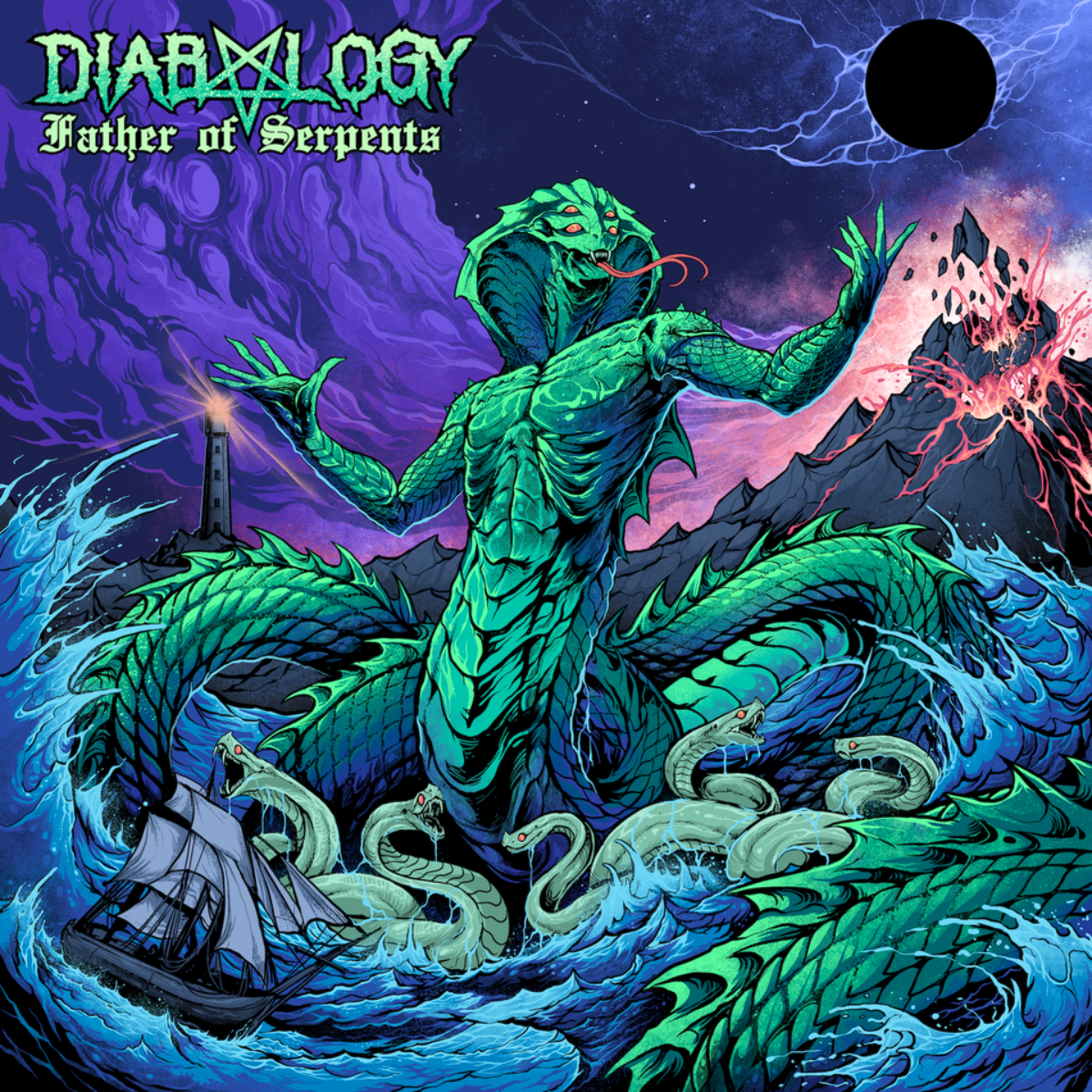
In the molten core of the thrash metal universe, a new entity has emerged, bearing the weight of the old gods while carving out a new domain entirely its own. Diabology, the thrash metal quartet hailing from Los Angeles, CA, has unleashed its sophomore effort, “Father of Serpents,” upon the world, a ten-track juggernaut that is both a homage to the genre’s roots and a declaration of the band’s arrival as a formidable force in the world of metal.
The album, released under Dissonant Hymns Records, was meticulously produced by Dave Kaminsky (Stone Healer, Fires in the Distance) and masterfully mastered by Ryan Williams (The Black Dahlia Murder, Metal Blade Records). Their touch has undoubtedly elevated the band’s sound, making “Father of Serpents” a sonic behemoth that demands to be heard.
The band, comprising Jesse Bergen (guitar and vocals), Basil Pav (guitar), Destin Treu (bass), and Matthew Morales (drums), met on the rock school circuit, united by their love of metal and a shared ambition to break free from the confines of their musical upbringing. “Father of Serpents” is a testament to that ambition, a mature and cohesive body of work that pays tribute to the thrash metal legends of the late eighties while injecting a youthful energy and freshness that is uniquely Diabology’s own.
Opening with the title track “Father of Serpents,” the album immediately sets the tone, a frenetic pace of razor-sharp riffs and relentless drumming that barely gives you a chance to catch your breath. It’s a fitting introduction to a band that refuses to pull punches, showcasing their technical prowess and intricate songwriting.
The album then weaves through a tapestry of dark and compelling themes, from the soul-shredding “Writhe” to the hauntingly beautiful “The Softest Grave.” Each track is a chapter in the story that Diabology is telling, a descent into the depths of human emotion and the darkness that lies within. “Eat My Heart Out” and “Spoil” are particular standouts, their visceral lyrics and soul crushing vocals serving as a cathartic release of pent-up aggression and raw emotion.
“Blackblood” and “March to Sea” continue the assault, their intricate guitar work and thundering bass lines a testament to the band’s musicianship and attention to detail. “Ode to Ogtha” and “Chimera” explore the more experimental side of Diabology’s sound, their willingness to push the boundaries of the genre evident in every note.
Closing out the album is “Lighthouse Hymn,” a hauntingly beautiful and aggressive track that serves as the perfect endcap to this sonic journey.
“Father of Serpents” is a devilishly good album that serves as both a homage to the thrash metal legends of yore and a declaration of Diabology’s arrival as a force to be reckoned with in the metal universe. With its intricate songwriting, technical prowess, and youthful energy, this is an album that demands to be heard, a venomous strike that will leave you begging for more.
Listen to the Album on SPOTIFY